
How Do Candles with LED Lights Work? A Technical Guide for B2B Buyers
September 11, 2026
Candles with LED lights work by combining a low-power LED, a battery, a control circuit, and a candle body designed to diffuse light. Unlike traditional candles, they do not need combustion to create illumination. Instead, the LED converts electrical energy into light, while the outer candle structure shapes that light into a flame-like visual effect. This makes an LED candle suitable for hospitality, events, home décor, retail displays, restaurants, and other commercial environments where open flames may create operational concerns.
For B2B buyers, understanding this mechanism matters because the internal components directly affect product performance, operating time, appearance, and maintenance requirements. A candle may look simple from the outside, but its internal design determines whether it provides stable illumination, realistic flickering, convenient battery replacement, and consistent performance across a large order.
The basic working sequence is straightforward. A battery supplies electrical energy to the circuit. The control circuit regulates the current and determines how the LED behaves. The LED then produces light through semiconductor-based electroluminescence. A diffuser, flame-shaped element, translucent wax shell, or plastic housing modifies the light before it reaches the viewer.
This basic architecture supports several product formats, including LED flameless candles, battery powered LED candles, and battery operated LED candles. Different configurations can also add timers, remote controls, multiple lighting modes, solar charging, or waterproof housings.
For buyers sourcing candles for commercial use, the important question is not simply whether an LED candle lights up. The more useful question is how the complete system produces the required visual effect and operating performance.
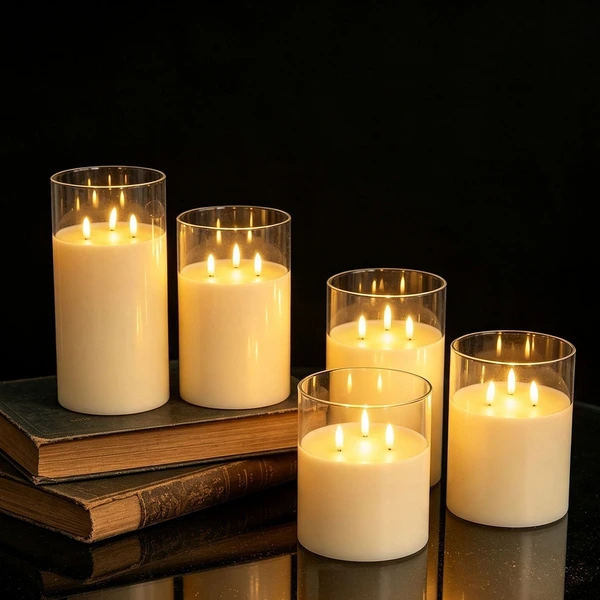
What Components Make an LED Candle Work?
An LED candle normally contains several coordinated components. Each component has a specific role in converting stored electrical energy into a candle-like visual effect.
1. LED light source
The LED is the light-producing component. LED stands for light-emitting diode. It uses a semiconductor junction to convert electrical current into visible light.
The U.S. Department of Energy explains that LEDs produce light when electrical current causes electrons and holes within a semiconductor to recombine. This process releases energy as photons. Unlike incandescent lighting, the process does not depend on heating a filament until it glows.
This distinction is important for candle applications. The LED requires very little physical space and can operate at relatively low power. Manufacturers can therefore place the light source inside compact candle bodies.
LEDs can also produce different colors and light intensities. Candle manufacturers commonly select warm light characteristics because they provide a visual appearance closer to conventional candlelight.
The LED itself, however, does not create the complete candle effect. The optical structure around it plays an equally important role.
2. Battery
The battery supplies the electrical energy needed by the LED and control system. A battery converts stored chemical energy into electrical energy through electrochemical reactions.
Common candle designs use compact batteries because LED technology requires relatively little electrical power. Depending on the product design, manufacturers may use replaceable button cells, cylindrical batteries, rechargeable batteries, or other compact battery formats.
Battery selection affects several commercial considerations:
- Operating time
- Product weight
- Candle dimensions
- Replacement frequency
- Shipping considerations
- User maintenance
- Recharge requirements
For example, a small decorative candle intended for short events may prioritize compact size. A hospitality application may place more emphasis on operating duration and simple battery replacement.
3. Control circuit
The control circuit manages how electrical power reaches the LED. In a simple product, this may involve little more than an on/off switch and current-control components.
More advanced designs can use a small integrated controller. The controller can create different light patterns, control brightness, activate a timer, or coordinate multiple LEDs.
This component is particularly important for flickering effects. A realistic candle usually does not keep its LED at one constant brightness. Instead, the controller changes the output over time.
4. Optical diffuser and flame element
The LED produces the initial light, but the candle body determines how people perceive that light.
A translucent wax body can diffuse the light across the candle surface. A flame-shaped element can create a localized glow near the top. Some designs use a combination of internal reflectors, diffusers, and flame-shaped components.
The optical structure can also reduce visible hotspots. Without appropriate diffusion, a viewer may see a bright LED point rather than a candle-like glow.
For commercial buyers, this difference can influence the perceived quality of the finished product. A candle used on a restaurant table, wedding table, hotel lobby, or retail display often needs a balanced glow rather than a visibly concentrated LED point.
5. Housing and exterior material
The exterior housing protects the electronics and creates the physical appearance of the candle.
Manufacturers may use wax, plastic, resin, or combinations of materials. Each material affects the visual effect, durability, weight, and production process.
Wax bodies can provide a more traditional candle appearance. Plastic bodies can support specific shapes, colors, and surface finishes. Outdoor products may require additional sealing and material considerations.
This is why an LED candle should be evaluated as a complete product rather than as an LED component alone.
How Does an LED Create a Realistic Flame Effect?
The most important difference between a basic LED light and a candle-style LED product is the behavior of the light.
A conventional LED can remain at a fixed brightness. A candle flame, however, constantly changes in intensity and appearance. Manufacturers therefore use optical and electronic methods to reproduce some of these characteristics.
Controlled flickering
The simplest approach uses a controller that changes LED brightness at programmed intervals.
The changes should avoid an obvious repeating pattern. If the LED turns on and off at a fixed rhythm, the effect can appear mechanical.
More sophisticated control systems use varied timing and brightness levels. This creates a less predictable light pattern and gives the impression of natural movement.
The goal is not to reproduce every physical feature of combustion. Instead, the system recreates the visual cues that people associate with a flame.
Flame-shaped elements
Some LED candles use a physical flame-shaped component above the LED.
The component may move slightly, diffuse the light, or contain reflective surfaces. When the LED changes intensity, the flame element responds visually.
This approach can create more depth than a flat LED positioned inside a candle shell.
Diffused illumination
The candle body also influences the flame effect.
A translucent material can spread light across the surface. This helps hide the exact location of the LED and creates a softer glow.
Material thickness and translucency therefore become important design variables. If the material blocks too much light, the candle may appear dim. If it transmits too much direct light, the LED may become visibly concentrated.
For product development, manufacturers normally balance the LED output with the material properties of the candle body.
Warm color characteristics
Traditional candles produce warm-colored light because combustion produces a broad spectrum of visible radiation with a strong warm appearance.
LED technology can reproduce a similar visual impression through appropriate LED selection and optical design.
The exact color specification depends on the intended product. A hospitality candle may require a warm, subtle glow. A decorative product may use a stronger orange or amber effect.
Color consistency also matters for bulk orders. Commercial buyers often need multiple candles to produce a uniform appearance across a venue or installation.
How Do Battery Powered LED Candles Control Their Operating Time?
Battery performance is one of the most important technical factors for B2B candle sourcing.
Battery powered LED candles depend on the relationship between battery capacity, LED power consumption, control electronics, and operating conditions.
A simplified relationship can be expressed as:
Operating time ≈ Available battery capacity ÷ Average current consumption
This equation provides a useful starting point, but actual performance depends on the battery type and circuit design.
Why LED power consumption matters
LEDs generally consume less electrical power than many conventional light sources. The U.S. Department of Energy identifies LED lighting as a form of solid-state lighting that uses semiconductor technology rather than heated filaments.
Lower power consumption can help extend battery life. It also allows manufacturers to use smaller batteries in compact candle designs.
However, battery life does not depend on the LED alone.
A timer, remote receiver, sensor, control chip, or multiple LEDs can also consume electrical energy. The overall system must therefore be considered when estimating operating time.
Timer functions
Timer functions can significantly change the practical battery replacement cycle.
For example, a candle may operate for a defined period after activation and then switch off automatically. This can reduce unnecessary operating hours.
For hospitality applications, timer functions can also simplify daily operation. Staff may not need to manually switch every candle on and off.
Replaceable versus rechargeable batteries
Battery operated LED candles commonly use replaceable batteries because they simplify product maintenance.
A replaceable battery design may suit restaurants, event companies, retailers, and hospitality businesses that operate many candles at the same time.
Rechargeable designs can reduce repeated battery replacement, but they introduce different requirements. Users may need charging stations, charging cables, storage space, and charging schedules.
The right configuration depends on the operating environment rather than one universal specification.
Practical battery considerations for buyers
When evaluating a candle supplier, B2B buyers should confirm:
| Requirement | Why It Matters |
|---|---|
| Battery type | Determines replacement and operating requirements |
| Battery capacity | Influences potential operating duration |
| Average current draw | Affects battery consumption |
| Timer setting | Can reduce unnecessary operating hours |
| Battery access | Determines maintenance convenience |
| Recharge method | Matters for rechargeable products |
| Storage conditions | Can affect battery performance |
| Product quantity | Influences replacement and maintenance workload |
Table 1. Key battery-related factors for evaluating LED candle products.
For a large commercial order, these details can have a meaningful effect on the total operating cost.
What Is the Difference Between LED Flameless Candles and Traditional Candles?
LED flameless candles use electronic light generation instead of combustion. This changes the way they operate, but it also changes the requirements for product design.
A traditional candle depends on wax, a wick, oxygen, and combustion. An LED version replaces the combustion system with an electronic lighting system.
No combustion process
A traditional candle produces light and heat through combustion. An LED candle produces light through a semiconductor device.
This fundamental difference allows an LED candle to operate without a burning wick.
For many commercial settings, the absence of an active flame can simplify product placement. Buyers may use these products in locations where an open flame would create additional operational restrictions.
The exact rules still depend on the venue, local regulations, insurance requirements, and application. Buyers should confirm the applicable requirements for their location.
More predictable operation
Electronic controls allow manufacturers to create repeatable lighting behavior.
For example, a product can include a defined timer cycle. Another model can include remote control functionality. A group of candles can also use the same control method.
These features are difficult to reproduce with conventional candles because combustion naturally varies with airflow, wax composition, wick condition, and other factors.
Reusability and maintenance
A traditional candle gradually consumes its wax body during operation. An LED candle does not burn through the candle body.
Instead, maintenance generally focuses on batteries, charging, cleaning, switches, and electronic components.
This makes the maintenance model different for commercial buyers.
A restaurant may use the same LED candles repeatedly across many service periods. An event company may transport the same inventory between venues. A hotel may keep candles in regular rotation for seasonal or daily décor.
Product appearance still matters
Removing the flame does not remove the need for visual realism.
For example, a supplier may offer realistic LED pillar candles that combine an LED light source with a pillar candle structure.
The external finish, flame shape, flicker pattern, and light diffusion all contribute to the final appearance.
How Should B2B Buyers Choose Battery Operated LED Candles?
The best product configuration depends on where and how the candles will operate.
A buyer purchasing candles for a restaurant may have different requirements from an event rental company. A hotel may prioritize operating consistency, while an outdoor décor project may require weather resistance.
Indoor hospitality applications
Restaurants, hotels, cafés, and banquet venues often need candles that can operate for several hours at a time.
Important factors include:
- Battery operating time
- Easy switching
- Timer functionality
- Stable light output
- Consistent appearance
- Easy battery replacement
For these applications, simple maintenance can be more important than advanced electronic functions.
Events and wedding venues
Event applications may involve hundreds of candles used for a limited period.
Buyers should consider inventory handling, battery replacement, storage, transport, and control methods.
If the same candle model is used across many tables, consistent light behavior becomes particularly important.
The purchasing team should also consider how quickly staff can prepare the candles before an event.
Outdoor applications
Outdoor use introduces additional technical requirements.
Moisture, rain, temperature changes, and sunlight can affect electronic products. Outdoor candles therefore need suitable housing and sealing.
For applications involving gardens, patios, outdoor dining, weddings, or seasonal displays, buyers may consider LED pillar candles waterproof solar power configurations.
Solar charging can reduce dependence on manual battery replacement in suitable outdoor environments. However, performance depends on sunlight exposure, panel size, battery capacity, weather conditions, and operating duration.
Retail and home décor programs
Retail buyers often need products with a clear visual identity and straightforward user operation.
Product packaging, candle size, remote control functions, battery requirements, and surface finish may all affect the final retail proposition.
For contemporary product programs, modern plastic LED candles can provide an alternative to traditional wax-style designs.
Choosing by application
A practical sourcing approach is to start with the operating environment.
| Application | Key Technical Priorities | Useful Features |
|---|---|---|
| Restaurant | Runtime and easy maintenance | Timer, replaceable battery |
| Hotel | Consistency and long-term use | Timer, remote control |
| Events | Batch consistency and setup speed | Remote control, grouped operation |
| Outdoor décor | Weather resistance | Waterproof housing, solar power |
| Retail | Appearance and user convenience | Remote control, multiple modes |
| Rental business | Durability and maintenance | Replaceable battery, robust housing |
Table 2. Application-based considerations for sourcing LED candle products.
The product should match the operating environment first. Decorative appearance should then be evaluated alongside the technical requirements.
What Should Buyers Check Before Placing a Bulk LED Candle Order?
A sample can confirm appearance, but B2B sourcing requires more than visual inspection.
Buyers should evaluate the technical specifications and operating behavior before approving a larger production order.
Check the light behavior
Turn on multiple samples at the same time.
Observe whether the flickering pattern looks consistent. Check whether individual candles have noticeable differences in brightness or color.
For commercial installations, consistency can matter more than the appearance of a single sample.
Check the battery compartment
Inspect how the battery fits inside the product.
A practical battery compartment should allow replacement without damaging the candle body or electronic components.
For high-volume applications, difficult battery replacement can create unnecessary labor.
Check the control system
If the product uses a remote control, check its effective operating range under realistic conditions.
For multiple candles, determine whether one remote can control several units.
Also confirm whether the product supports multiple operating modes and whether settings remain consistent after switching the candle off.
Check material and construction
The outer material should match the intended environment.
For indoor products, the focus may be surface finish and visual appearance. Outdoor products require additional attention to moisture resistance and housing construction.
Buyers should also inspect seams, switches, battery covers, flame elements, and other mechanical interfaces.
Confirm production consistency
For large orders, sample approval should establish measurable specifications.
These may include:
- Candle dimensions
- Material
- LED color
- Flicker behavior
- Battery type
- Battery capacity
- Operating mode
- Timer duration
- Remote control function
- Packaging requirements
A clear specification reduces uncertainty during mass production.
Consider customization requirements
OEM and private-label programs may require changes to the candle body, surface finish, packaging, lighting behavior, control method, or battery configuration.
The earlier these requirements are defined, the easier it becomes to evaluate production feasibility.
For buyers developing a new candle program, technical discussions should therefore happen before final packaging and artwork decisions.
Frequently Asked Questions About LED Candles
How does an LED candle produce light?
An LED candle uses an LED semiconductor to convert electrical energy into visible light. A battery supplies the electrical energy, while the control circuit regulates the LED. Diffusers and flame-shaped components then create the candle-like appearance.
Are LED flameless candles safe to leave unattended?
LED flameless candles do not use an active combustion flame. However, users should follow the manufacturer’s instructions for battery use, charging, placement, and operation. Safety requirements can vary by product and application.
How long do battery powered LED candles last?
Operating time depends on battery capacity, LED power consumption, control electronics, timer settings, and usage patterns. A supplier should provide tested operating data for the specific product configuration.
Can battery operated LED candles use rechargeable batteries?
Some models can use rechargeable batteries, while others are designed for specific disposable battery types. Buyers should confirm battery compatibility before changing the specified battery.
Why do some LED candles flicker?
The control circuit can vary the LED’s brightness over time. This creates a changing light pattern that resembles the visual movement of a candle flame.
Can LED candles be used outdoors?
Some LED candles are designed for outdoor use, but indoor and outdoor models should not be treated as interchangeable. Outdoor products require suitable protection against moisture and environmental exposure.
Can LED candles have remote controls?
Yes. Some LED candles use infrared or radio-based remote control systems. Depending on the design, a remote can control functions such as power, brightness, timer settings, or lighting modes.
What should a buyer request from an LED candle manufacturer?
A B2B buyer should request product dimensions, material information, battery type, operating time, lighting mode, control method, customization options, packaging details, and sample specifications.
How Does Jiaye Support LED Candle Sourcing?
Jiaye focuses on LED candle manufacturing for buyers that need products for commercial, retail, hospitality, event, and decorative applications. The company develops LED candle products around the relationship between electronic components, candle materials, optical diffusion, battery configuration, and finished-product appearance.
For B2B projects, the key value of a manufacturer is not simply the ability to produce a candle that lights up. Consistent specifications, controlled production, suitable materials, and clear communication all influence the success of a bulk program.
Jiaye provides different LED candle configurations for different application requirements. Buyers can discuss candle dimensions, lighting effects, battery options, control functions, outdoor requirements, packaging, and other project specifications before production.
Understanding how an LED candle works makes product selection more precise. Instead of evaluating only the external appearance, buyers can assess the complete system behind the product. That approach helps align the candle with its intended operating environment and commercial requirements.
References
- U.S. Department of Energy, “LED Basics”: https://www.energy.gov/cmei/ssl/led-basics
- U.S. Department of Energy, “DOE Explains… Batteries”: https://www.energy.gov/science/doe-explainsbatteries
- U.S. Department of Energy, “How LED Lighting Works”: https://www.energy.gov/management/articles/energysavingslightemittingdiodesnichelightingappspdf
- U.S. Department of Energy, “The History of the Light Bulb”: https://www.energy.gov/articles/history-light-bulb
- U.S. Department of Energy, “Cooling with Electroluminescent Semiconductors”: https://www.energy.gov/science/bes/articles/cooling-electroluminescent-semiconductors







.png)