Are LED Candles Waterproof Enough for Outdoor and Hospitality Use?
September 18, 2026
Yes, some LED candles are designed for water-resistant or waterproof applications, but not every LED candle can handle water. For B2B buyers, the key question is not simply whether an LED candle is waterproof. The more useful question is which level of water protection matches the intended environment. Indoor table settings, covered patios, outdoor weddings, poolside displays, restaurants, hotels, and decorative installations can all require different protection levels. Buyers should check the enclosure design, battery compartment, sealing method, test requirements, and stated IP rating before selecting a product.
Water exposure can affect more than the LED itself. Moisture can reach the battery compartment, switch, circuit board, or electrical contacts. A candle may continue to illuminate after light rain but fail after repeated exposure or temporary immersion. Therefore, product specifications should clearly define the intended use rather than relying on a general term such as “waterproof.”
For distributors, hospitality suppliers, event companies, and private-label brands, this distinction also affects product positioning. A standard indoor LED candle may suit restaurants and home décor. A sealed outdoor model requires different housing and testing considerations. Custom specifications may also affect battery type, operating time, dimensions, packaging, and production cost.
What Makes an LED Candle Water Resistant or Waterproof?
An LED candle becomes suitable for wet environments through a combination of enclosure design, component protection, sealing, and testing. The LED light source itself usually requires little attention compared with the areas where moisture can enter.
The housing must protect the internal electronics from water exposure. Designers may use sealed joints, gaskets, waterproof switches, protected battery compartments, or other enclosure methods. The exact structure depends on the product design and its intended environment.
The International Electrotechnical Commission defines the IP Code under IEC 60529. This standard classifies the protection provided by enclosures against factors such as solid objects and water ingress.
IP Ratings Matter More Than the Word “Waterproof”
For B2B sourcing, an IP rating provides a more useful technical reference than a general waterproof claim. The rating normally uses two digits.
The first digit concerns protection against solid objects. The second digit concerns protection against water. Different water protection levels correspond to different test conditions.
This means an LED candle with a stated IP rating gives buyers more information than a product description that simply says “waterproof.” However, the rating should still match the actual application.
For example, a candle intended for occasional outdoor use under a covered terrace may not require the same protection as a product designed for temporary immersion.
The following table provides a practical interpretation for purchasing discussions.
The table should be treated as a sourcing framework rather than a universal specification. Actual suitability depends on the product’s tested enclosure and operating instructions.
Can LED Flameless Candles Be Used Outdoors?
Yes, but only when the product design supports outdoor exposure. An indoor LED candle should not automatically move into an outdoor application because it does not produce a real flame.
This distinction matters because flameless operation solves the combustion issue, not the moisture issue. A battery-powered LED candle can avoid the open-flame risks associated with traditional candles, while its electronic components still require protection from water.
For outdoor hospitality applications, buyers should consider several environmental factors.
Rain Exposure
Rain creates direct water contact with the candle housing. Repeated exposure can also increase the chance of moisture entering through seams, switches, or battery covers.
A product designed for outdoor use should therefore have an enclosure appropriate to its stated water protection level. Packaging and product instructions should also explain whether the candle can remain outdoors continuously.
Condensation and Humidity
Outdoor products face more than visible rain. Temperature changes can produce condensation around or inside an enclosure.
High humidity may also affect electrical contacts over extended periods. This is particularly relevant for products used in coastal locations, outdoor dining areas, resorts, and event venues.
Cleaning and Maintenance
Commercial users often clean decorative products more frequently than residential users. A candle placed on restaurant tables may encounter water, cleaning sprays, or damp cloths.
A product that tolerates light splashing may still have limitations around direct spraying or immersion. Buyers should therefore distinguish between normal cleaning exposure and deliberate washing.
Poolside and Event Applications
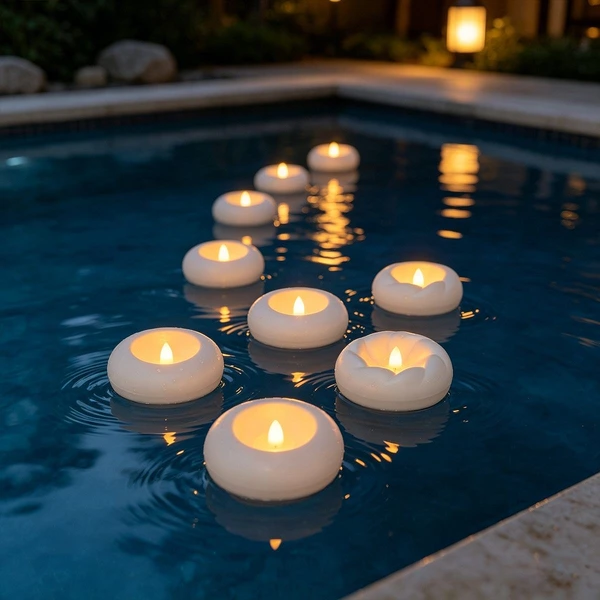
Poolside installations create another level of exposure. Water can reach products through splashes, wet hands, accidental drops, or cleaning operations.
For these applications, the buyer should request specific information about water protection rather than relying on the product title. The intended environment should be discussed before finalizing the product specification.
What Should B2B Buyers Check Before Ordering Waterproof LED Candles?
Water resistance should be treated as one part of a larger product specification. A suitable candle must also meet requirements for operating time, battery access, appearance, packaging, and intended market.
For distributors and private-label brands, these details can affect returns and customer expectations. A product described as outdoor-ready should have specifications that support that positioning.
1. Confirm the Intended Water Exposure
Start by defining where the product will operate.
A hotel may need candles for indoor banquet tables and outdoor terraces. An event supplier may need products that can tolerate rain during temporary outdoor installations. A poolside hospitality project may need protection against frequent splashes.
These applications should not share the same specification by default.
2. Check the IP Rating or Equivalent Test Information
Ask the supplier to provide the applicable IP rating when water protection is a purchasing requirement.
IEC 60529 provides the framework for IP enclosure classifications. It covers the degree of protection provided by electrical equipment enclosures.
A buyer should also confirm whether the tested configuration matches the final commercial product. Changes to the battery compartment, switch, housing, or assembly can affect water protection.
3. Examine the Battery Compartment
The battery compartment deserves particular attention because it creates a potential entry point for moisture.
A sealed battery compartment can improve water resistance, but it may also change how users replace batteries. A commercial buyer must balance protection with maintenance requirements.
Battery type also affects product design. Some candles use replaceable batteries, while others use rechargeable battery systems.
Products using button or coin batteries require additional safety considerations. In 2026, the U.S. Consumer Product Safety Commission issued warnings involving LED waterproof candle lights and LED flameless candle sets because accessible coin batteries created ingestion hazards.
This does not mean all LED candles present the same risk. It does mean battery compartment design and required warnings should form part of the product specification.
4. Confirm Operating Time
Battery life becomes more important when candles are used in hotels, restaurants, venues, or events.
A commercial operator may run hundreds of candles for several hours each evening. Frequent battery replacement can increase labor requirements.
Buyers should compare:
- Battery type
- Number of batteries
- Rated operating time
- Light mode
- Remote-control functions
- Timer function
- Rechargeability
- Replacement method
Operating time should come from the actual product configuration rather than a generic battery estimate.
If a buyer needs a large quantity for hospitality use, a supplier can also help assess whether a different battery configuration would better suit the operating schedule.
Discuss your required outdoor, hospitality, or private-label LED candle specification with Jiaye.
How Do Battery-Powered LED Candles Differ for Outdoor Applications?
Battery selection affects both operating convenience and enclosure design. For many decorative applications, buyers choose battery-powered products because they avoid cables and simplify placement.
This is especially useful for restaurants, wedding venues, hotels, event companies, and seasonal décor suppliers.
Battery Access Versus Water Protection
There is a practical trade-off between easy battery replacement and enclosure protection.
A frequently opened battery compartment creates more opportunities for incorrect installation or damaged seals. A highly protected enclosure may require a more controlled battery replacement process.
For commercial buyers, this means the battery design should match the expected operating model.
For example, a restaurant operating 300 candles every evening may value quick battery replacement. A hotel using candles for occasional events may prioritize long storage life and extended operating time.
Battery-Operated Candle Product Planning
Buyers sourcing battery operated LED candles should define whether the product is intended primarily for indoor or outdoor use.
The specification can then address housing structure, battery compartment design, switch location, remote control, timer settings, and operating time.
This approach prevents the common mistake of selecting a candle first and trying to add outdoor protection later.
How Can OEM and ODM Specifications Improve Waterproof LED Candle Projects?
Water resistance becomes more complex when a buyer wants a private-label or custom product. A standard model may already have a fixed housing, battery compartment, and light module.
A customized project can change those elements.
OEM and ODM planning should therefore begin with the application rather than the appearance alone.
OEM LED Lights for Defined Product Requirements
For buyers with an established product specification, OEM LED lights can provide a way to manufacture against defined requirements.
The buyer may already know the candle dimensions, housing material, color, battery configuration, operating time, light effect, packaging, and target market.
The manufacturer can then review which specifications are compatible with the existing production structure.
Water protection should remain part of the technical specification. It should not appear only as a marketing term on the final package.
Custom LED Light Development
A custom LED light project can involve changes to the exterior housing, flame effect, light color, control method, or battery structure.
For an outdoor candle, the housing design may need to accommodate additional sealing requirements. This can affect mold design and assembly.
The buyer should therefore review the full product structure before approving a custom sample.
Custom Made LED Lights for Different Applications
Custom made led lights may serve different commercial environments.
A wedding supplier may want a realistic flame effect and timer. A hotel may need a consistent warm light across hundreds of units. A restaurant may prioritize quick battery replacement.
A poolside décor supplier may focus more heavily on water protection.
These requirements can lead to different product designs even when all products are sold as LED candles.
ODM LED Lights for New Product Concepts
ODM LED lights are more suitable when the buyer wants to develop a product concept with the manufacturer’s design and engineering capabilities.
An ODM project may involve selecting an existing platform and modifying its size, housing, light effect, battery system, control method, or packaging.
For a new waterproof candle range, this approach can shorten the development path when an existing product architecture already meets part of the requirement.
However, the final product still needs specification review and appropriate testing for its intended market.
Which LED Candle Design Fits Different B2B Applications?
The best specification depends on how the product will operate. There is no single candle configuration that suits every commercial environment.
A useful purchasing process starts with the installation scenario.
Hotels and Restaurants
Hotels and restaurants often use candles on dining tables, reception desks, banquet tables, and outdoor terraces.
Indoor products may prioritize appearance, operating time, and quick maintenance. Outdoor terrace products need greater attention to moisture exposure.
For restaurants, battery replacement can also become a labor issue. A product with a practical battery compartment may reduce maintenance time.
Wedding and Event Companies
Event suppliers often transport and reuse candles across different venues.
They may need products with consistent appearance, stable operating time, remote controls, timers, and suitable outdoor protection.
Storage also matters. Products should tolerate repeated handling and packaging without damaging the housing or controls.
Resorts and Outdoor Hospitality
Resorts may use LED candles around gardens, patios, pools, walkways, and outdoor dining areas.
These environments can expose products to humidity, rain, splashes, and cleaning activities.
The buyer should define the exact exposure level before choosing the water protection specification.
Home Décor and Retail Products
Retail products often focus on appearance, packaging, operating simplicity, and price positioning.
Not every decorative candle needs outdoor protection. Adding unnecessary protection can increase product complexity and cost.
For a retail range, it can make more sense to offer separate indoor and outdoor models.
How Should Buyers Compare Waterproof LED Candles?
A technical comparison should go beyond candle shape and price. B2B buyers need to evaluate the entire product configuration.
The following framework can support supplier discussions.
Product Construction
Review the housing material, dimensions, flame structure, LED module, switch design, and battery compartment.
If the candle will operate outdoors, ask which components provide the water protection.
Electrical and Battery Specifications
Confirm battery type, quantity, rated operating time, charging method if applicable, and replacement process.
For products using coin or button batteries, confirm that the battery compartment and required warnings meet the regulations of the target market. Recent CPSC enforcement actions show why this detail deserves attention.
Environmental Requirements
Define the expected exposure before production.
Consider:
- Indoor use
- Occasional splashing
- Covered outdoor use
- Rain exposure
- Poolside use
- Temporary immersion
- High humidity
- Frequent cleaning
This list gives the supplier a practical starting point for product selection.
Documentation
For B2B projects, request supporting documentation for the claims that matter to the project.
This may include water protection test information, battery specifications, product drawings, packaging details, and applicable compliance documentation.
A clear specification reduces ambiguity between the buyer, manufacturer, testing laboratory, and final customer.
FAQ About Waterproof LED Candles
Are all LED candles waterproof?
No. LED candles use electronic components, so their water resistance depends on the enclosure and internal design.
Some models are intended for indoor use only. Others have water-resistant or waterproof construction for specified outdoor applications.
Can LED flameless candles be left outside in the rain?
Only when the specific model is designed and rated for that environment. A flameless design does not automatically make a candle waterproof.
Buyers should check the manufacturer’s water protection specification and usage instructions.
Are battery powered LED candles suitable for outdoor events?
They can be suitable when the product has the required environmental protection and battery design.
Outdoor event buyers should also consider operating time, rain exposure, battery replacement, transport, and storage.
What does an IP rating mean for an LED candle?
An IP rating describes the degree of protection provided by an enclosure against solid objects and water under defined test conditions.
IEC 60529 establishes the IP Code classification system.
The rating should be considered together with the manufacturer’s stated application limits.
Can waterproof LED candles be submerged?
Not necessarily. Water protection levels differ.
A product designed to resist splashing does not automatically support immersion. Buyers should check the specific test level and product instructions before using a candle underwater.
Are battery operated LED candles safer than real candles?
LED candles eliminate the open flame associated with traditional candles. This can make them useful for applications where open flames create practical concerns.
However, electronic products still require appropriate battery and electrical safety controls. CPSC has issued recent warnings involving accessible coin batteries in some LED candle products.
Can I order custom waterproof LED candles?
Yes, custom projects can address dimensions, housing, light effects, battery configuration, control methods, packaging, and other requirements.
The required water protection should be defined before sampling because enclosure changes can affect tooling and internal components.
What should I provide when requesting an OEM LED candle?
Provide the intended application, target market, dimensions, light effect, battery preference, operating time, water exposure, packaging requirements, and expected order quantity.
If you have a reference product, photos, drawings, or samples can also help the manufacturer evaluate the project.
What is the difference between OEM and ODM LED lights?
OEM projects generally follow buyer-defined specifications. ODM projects usually involve a manufacturer’s existing design or development capability.
For LED candles, both approaches can support private-label programs. The appropriate route depends on how much of the product design is already defined.
Conclusion: Waterproof Performance Should Match the Application
The answer to “are LED candles waterproof?” depends on the product’s construction and intended environment. Some LED candles can handle outdoor exposure, while others are designed strictly for indoor decoration.
For B2B buyers, water protection should therefore be treated as a measurable product requirement. The evaluation should cover enclosure design, IP classification where applicable, battery compartment construction, operating time, maintenance, and target-market requirements.
A hotel terrace, wedding venue, restaurant table, and poolside installation may all need different specifications. Selecting the right product starts by defining the exposure conditions rather than choosing a generic “waterproof” label.
For buyers developing private-label ranges, OEM and ODM options can also support application-specific designs. The same product platform may require different housing, battery, control, or packaging configurations for different markets.
Jiaye supplies LED candle products for B2B sourcing programs and can support product requirements across standard and customized configurations. As an experienced LED candle manufacturer, Jiaye works with buyers who need defined product specifications, private-label development, and application-oriented candle solutions.
References
- International Electrotechnical Commission, IEC 60529, Degrees of protection provided by enclosures (IP Code). IEC 60529 official reference
- International Electrotechnical Commission, IEC 60529 consolidated version with amendments. IEC 60529 consolidated standard
- U.S. Consumer Product Safety Commission, warning concerning LED Waterproof Candle Lights and accessible coin batteries, August 2026. CPSC product safety warning
- U.S. Consumer Product Safety Commission, warning concerning LED Flameless Candle Sets and coin battery requirements, March 2026. CPSC LED flameless candle safety warning






.png)